Monday, 30 November 2015

"Successful media products depend as much upon marketing and distribution to a specific audience as they do upon good production practices"
To what extent would you agree with this this statement, within the media area you have studied?
I believe that for a British film to be successful it must be profitable, if a British film wins awards this emphasises its success as it connotes its recognition and popularity amongst its specific audience. An American film also needs to make profits to be successful, these profits are often a lot larger than those generated by a British film but I don't consider this to make the American film more successful. American films have expanded their audiences by including Chinese locations therefore this increases the movies profit because more people in China will go and see the film. This ability to inflate the target audience of the film makes an American film more successful.
Two films I have studied are: 'Mad Max: Fury Road', an American film directed by George Miller and 'Ex Machina' a British film produced by DNA Films and Film 4 producers and directed by Alex Garland. Both films made healthy profits and succeeded in reaching their specific target audience. 'Mad Max: Fury Road' presents the story of a female warrior 'Furiosa' and her alliances on a pursuit of escape, it features successful and well known actors; Tom Hardy and Charlize Theron. 'Ex Machina' tells the story of a computer coder played by Domhall Gleeson and his experience with a bio-engineered robot, 'Ava', played by Alicia Vikander.
A contributing factor to 'Mad Max: Fury Road' being a success is its cast. Tom Hardy plays Max, he is a well known actor that has featured in other successful action movies like 'The Dark Knight Rises' and 'Inception'. This background gives a positive base of a specific audience therefore appeals to mainstream audiences that enjoy action movies and fans of Tom Hardy will be attracted to the movie as they know they've enjoyed his previous performances, also the gaze theory increases the audiences attracted to the movie. Featuring Charlize Theron and Nicholas Hoult, creates the expectation that the film will be impressive, this enticing reputation will encourage even the likes of less common cinema goers to see the film; these production practices are important for a film to be successful through profit. Also, this sequel of 'Mad Max' (1979), 'Mad Max 2' (1981) and 'Mad Max Beyond Thunderdome' (1985) had a crew of 1,700 workers on the film set including 150 stunt performers. This large crew and successful previous movies provide predictable success. The making of the movie faced challenges such as dealing with the weather conditions like the extreme dust and also rain on multiple occasions which meant the crew needed specialised waterproof and dustproof equipment. Another problem faced by the team was managing to film with all different camera angles in a moving environment to capture the scenes in the best way possible. The constant movement while filming was what Charlize Theron believed was 'tricky' about the production. Recognisably, the movie conforms to containing Summer Blockbuster conventions like impressive explosions and exciting car chases and successfully attract a mainstream audience therefore relied on action over plot. For example, 'Mad Max: Fury Road' contains a lot of car chases specifically a very exciting one as 'Furiosa' drives the war rig into a dust storm and is followed by the war boys; to make this scene as impressive as it was production practices like camera angles and movement were very important. Also, a very tasking scene is when the war rig blows up, to create this very visually appealing image the crew took mobile refinery out into the desert and drove it remotely and surrounded it by camera cars. This explosion is a contributing factor to the films success as it adds to fulfilling the films expectation of a hollywood blockbuster it also would entice audiences that enjoy action packed and visually thrilling. These appealing features urge the target audience to see the movie in cinemas as that is where the film is shown at its best therefore the film increases its profits. Certain scenes like when the war rig blows up are known to look better in cinemas. The film made $374 million at the box office.
Unlike 'Mad Max:Fury Road' a British film like 'Ex Machina' didn't have such an allowing budget, it featured less well known but undoubtably upcoming actors and actresses. Domhall Gleeson and Alicia Vikander are to appear in the upcoming 2015 'Star Wars: The Force Awakens' a very popular sequel which similar to 'Ex Machina' appeals to 'films buffs'. 'Ex Machina' relies on a strong script to entice its specific target audience of 'film buffs', a good plot is more important than action in this movie. Instead of using computer generated imagery the crew rotoscoped the body of 'Ava' which took a lot of time but created a sensation on 'the big screen'. Using a production practice like editing a body onto a robot takes time; a scene that would have been difficult to create would have been when Ava runs towards Nathan, the fast pace contrasts with the rest of the movie to create an effective scene but made rotoscoping more difficult.The movie reached its specific audience therefore made a healthy profit of $6.9 million. 'Ex Machina' challenges institutional practices.
A sum of $7 million was spent on television advertising of 'Mad Max: Fury Road' in order to reach the specific audience of this blockbuster, television is the most effective method of marketing. The TV trailers featured small snippets of the film to portray the general idea of the movie. In marketing the film it typically became influenced by the production practices used, its marketing would be used to demonstrate these(e.g. car chases and explosions) to portray the film at its most appealing. An example of a scene the trailer shows is within its opening; Max is being chased by War boys and almost ends up running over the edge of a cliff, the shot then cuts to Max leaping from the cliff but then doesn't reveal its outcome. The cliff scene, ironically, leaves a cliff-hanger where the audience want to see more. The scene used in the trailer immediately demonstrates the fast pace of the movie and how it will contain fight scenes and thrilling chase scenes. In collaboration with the trailers, film posters were released featuring Tom Hardy and Charlize Theron, this created a 'buzz' over the well known faces therefore enticed their fans to see the movie. The marketing of 'Mad Max: Fury Road' lead to the specific target audience(mainstream) facilitating the studios by going to see the film at the cinema. In comparison, 'Ex Machina' used fairly minimal marketing methods. It used digital initiative creating modern accounts on popular applications. This enabled the crew of 'Ex Machina' to exploit social media to promote the film with either very small costs or for free to its target market. This unique marketing method was hugely effective as it reached 'film buffs' that would go to see the film.
Distribution plays a key role in the success of a film. 'Mad Max: Fury Road' used a wide release on many IMAX screens. On the 14th May 2015 'Mad Max: Fury Road' opened on 12,000 screens in 48 countries. In the United States and Canada the movie opened on 3,702 screens and earned $16.77 million on its opening day. This is similar to other blockbusters like 'Transformers age of Extinction' and 'Avengers: Age of Ultron'. The film was originally planned to be shot in 3D but the crew changed to more straightforward 2D shooting, audiences would engage well with this as 3D revenues have been decreasing as the fascination has faded. The film needs to distribute well or people would challenge institutional practices and not watch the movie in the cinema but choose to use 'Netflix' or an alternative source.
'Ex Machina' was released through universal pictures on the 21st January 2015 in the UK. The film at first, was only shown on one or two screens using modified wide release as the new release of 'Avengers: Age of Ultron' dominated the cinema screens. 'Ex Machina' then piggy backed the 'Avengers' sequel by increasing the number of screens it was shown on as 'Avengers' decreased. The films specific target audience facilitated the studios as they went to see 'Ex Machina' as its screens increased.
I agree that successful media products depend as much upon marketing and distribution to a specific audience as they do upon good production practices. I think that in years to come methods of marketing will need to change and adapt to more fresh and exciting ideas. The marketing of 'Ex Machina' supports this because although it wasn't expensive; it was new and unexpected which is an effective factor and appealing to audiences of the current generation. I think that while action movies are increasingly overtaking other genres of the film industry there are films that are already being made, e.g. there are fifty marvel films to be produced within the next ten years. However, this genre is currently popular, I predict that it will become too familiar and less of an experience to see at a cinema therefore audiences will gravitate towards other genres that are more exclusive and interesting for them to see. The contributes to how a film will need to expand its methods of marketing and distribution to make a profit and in turn generate a successful profit.
To what extent would you agree with this this statement, within the media area you have studied?
I believe that for a British film to be successful it must be profitable, if a British film wins awards this emphasises its success as it connotes its recognition and popularity amongst its specific audience. An American film also needs to make profits to be successful, these profits are often a lot larger than those generated by a British film but I don't consider this to make the American film more successful. American films have expanded their audiences by including Chinese locations therefore this increases the movies profit because more people in China will go and see the film. This ability to inflate the target audience of the film makes an American film more successful.
Two films I have studied are: 'Mad Max: Fury Road', an American film directed by George Miller and 'Ex Machina' a British film produced by DNA Films and Film 4 producers and directed by Alex Garland. Both films made healthy profits and succeeded in reaching their specific target audience. 'Mad Max: Fury Road' presents the story of a female warrior 'Furiosa' and her alliances on a pursuit of escape, it features successful and well known actors; Tom Hardy and Charlize Theron. 'Ex Machina' tells the story of a computer coder played by Domhall Gleeson and his experience with a bio-engineered robot, 'Ava', played by Alicia Vikander.
A contributing factor to 'Mad Max: Fury Road' being a success is its cast. Tom Hardy plays Max, he is a well known actor that has featured in other successful action movies like 'The Dark Knight Rises' and 'Inception'. This background gives a positive base of a specific audience therefore appeals to mainstream audiences that enjoy action movies and fans of Tom Hardy will be attracted to the movie as they know they've enjoyed his previous performances, also the gaze theory increases the audiences attracted to the movie. Featuring Charlize Theron and Nicholas Hoult, creates the expectation that the film will be impressive, this enticing reputation will encourage even the likes of less common cinema goers to see the film; these production practices are important for a film to be successful through profit. Also, this sequel of 'Mad Max' (1979), 'Mad Max 2' (1981) and 'Mad Max Beyond Thunderdome' (1985) had a crew of 1,700 workers on the film set including 150 stunt performers. This large crew and successful previous movies provide predictable success. The making of the movie faced challenges such as dealing with the weather conditions like the extreme dust and also rain on multiple occasions which meant the crew needed specialised waterproof and dustproof equipment. Another problem faced by the team was managing to film with all different camera angles in a moving environment to capture the scenes in the best way possible. The constant movement while filming was what Charlize Theron believed was 'tricky' about the production. Recognisably, the movie conforms to containing Summer Blockbuster conventions like impressive explosions and exciting car chases and successfully attract a mainstream audience therefore relied on action over plot. For example, 'Mad Max: Fury Road' contains a lot of car chases specifically a very exciting one as 'Furiosa' drives the war rig into a dust storm and is followed by the war boys; to make this scene as impressive as it was production practices like camera angles and movement were very important. Also, a very tasking scene is when the war rig blows up, to create this very visually appealing image the crew took mobile refinery out into the desert and drove it remotely and surrounded it by camera cars. This explosion is a contributing factor to the films success as it adds to fulfilling the films expectation of a hollywood blockbuster it also would entice audiences that enjoy action packed and visually thrilling. These appealing features urge the target audience to see the movie in cinemas as that is where the film is shown at its best therefore the film increases its profits. Certain scenes like when the war rig blows up are known to look better in cinemas. The film made $374 million at the box office.
Unlike 'Mad Max:Fury Road' a British film like 'Ex Machina' didn't have such an allowing budget, it featured less well known but undoubtably upcoming actors and actresses. Domhall Gleeson and Alicia Vikander are to appear in the upcoming 2015 'Star Wars: The Force Awakens' a very popular sequel which similar to 'Ex Machina' appeals to 'films buffs'. 'Ex Machina' relies on a strong script to entice its specific target audience of 'film buffs', a good plot is more important than action in this movie. Instead of using computer generated imagery the crew rotoscoped the body of 'Ava' which took a lot of time but created a sensation on 'the big screen'. Using a production practice like editing a body onto a robot takes time; a scene that would have been difficult to create would have been when Ava runs towards Nathan, the fast pace contrasts with the rest of the movie to create an effective scene but made rotoscoping more difficult.The movie reached its specific audience therefore made a healthy profit of $6.9 million. 'Ex Machina' challenges institutional practices.
A sum of $7 million was spent on television advertising of 'Mad Max: Fury Road' in order to reach the specific audience of this blockbuster, television is the most effective method of marketing. The TV trailers featured small snippets of the film to portray the general idea of the movie. In marketing the film it typically became influenced by the production practices used, its marketing would be used to demonstrate these(e.g. car chases and explosions) to portray the film at its most appealing. An example of a scene the trailer shows is within its opening; Max is being chased by War boys and almost ends up running over the edge of a cliff, the shot then cuts to Max leaping from the cliff but then doesn't reveal its outcome. The cliff scene, ironically, leaves a cliff-hanger where the audience want to see more. The scene used in the trailer immediately demonstrates the fast pace of the movie and how it will contain fight scenes and thrilling chase scenes. In collaboration with the trailers, film posters were released featuring Tom Hardy and Charlize Theron, this created a 'buzz' over the well known faces therefore enticed their fans to see the movie. The marketing of 'Mad Max: Fury Road' lead to the specific target audience(mainstream) facilitating the studios by going to see the film at the cinema. In comparison, 'Ex Machina' used fairly minimal marketing methods. It used digital initiative creating modern accounts on popular applications. This enabled the crew of 'Ex Machina' to exploit social media to promote the film with either very small costs or for free to its target market. This unique marketing method was hugely effective as it reached 'film buffs' that would go to see the film.
Distribution plays a key role in the success of a film. 'Mad Max: Fury Road' used a wide release on many IMAX screens. On the 14th May 2015 'Mad Max: Fury Road' opened on 12,000 screens in 48 countries. In the United States and Canada the movie opened on 3,702 screens and earned $16.77 million on its opening day. This is similar to other blockbusters like 'Transformers age of Extinction' and 'Avengers: Age of Ultron'. The film was originally planned to be shot in 3D but the crew changed to more straightforward 2D shooting, audiences would engage well with this as 3D revenues have been decreasing as the fascination has faded. The film needs to distribute well or people would challenge institutional practices and not watch the movie in the cinema but choose to use 'Netflix' or an alternative source.
'Ex Machina' was released through universal pictures on the 21st January 2015 in the UK. The film at first, was only shown on one or two screens using modified wide release as the new release of 'Avengers: Age of Ultron' dominated the cinema screens. 'Ex Machina' then piggy backed the 'Avengers' sequel by increasing the number of screens it was shown on as 'Avengers' decreased. The films specific target audience facilitated the studios as they went to see 'Ex Machina' as its screens increased.
I agree that successful media products depend as much upon marketing and distribution to a specific audience as they do upon good production practices. I think that in years to come methods of marketing will need to change and adapt to more fresh and exciting ideas. The marketing of 'Ex Machina' supports this because although it wasn't expensive; it was new and unexpected which is an effective factor and appealing to audiences of the current generation. I think that while action movies are increasingly overtaking other genres of the film industry there are films that are already being made, e.g. there are fifty marvel films to be produced within the next ten years. However, this genre is currently popular, I predict that it will become too familiar and less of an experience to see at a cinema therefore audiences will gravitate towards other genres that are more exclusive and interesting for them to see. The contributes to how a film will need to expand its methods of marketing and distribution to make a profit and in turn generate a successful profit.
Thursday, 26 November 2015
The 'British' Film Industry

Who did what in the British film industry?
- BBFC (British Board of Film Classification): An independent non-government body which classifies and sensors film, video as well a computer and console based games released in the UK.
- UK Film Council: Promotes understanding and appreciation of Britain's rich film and television heritage and culture.
- BFI (British Film Industry): The official UK agency for international cultural relations. Its film department promotes new British films (features and shorts), internationally principally through festivals and showcases.
- British Academy: aims to support, develop and promote the art forms of the moving image.
- British Council: Government backed lead agency for film in the UK ensuring that the economic, cultural and educational aspects of film are effectively represented at home and abroad.
The production company Film4 has produced films such as:
- Ex Machina
- Slumdog Millionaire
- Sightseers
Working Title:
- Everest
- Love Actually
- Les Miserables
Momentum Pictures
- The woman in Black(sequel)
- Yakuza Apocalypse
Pathe:
- Beauty and the Beast
- Selma
- The Iron Lady
BBC Film Network:
- The Last Man on Earth
- The World Turns
British Vs American
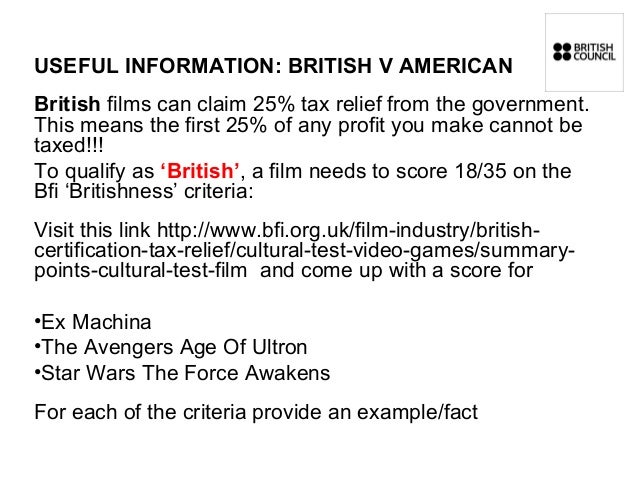
British films can claim 25% tax relief from the government therefore this is appealing to film makers, including large budget Hollywood blockbusters.
The points some films scored on the 'Britishness Test':
Ex Machina - 32
Avengers - 22
Star Wars The Force Awakens - 23
How do British films attract audiences(consider how the films might attract either a British or global audience)?
In the case of 'Ex Machina' the movie appeals to film buffs therefore the sci-fi genre effectively attracts audiences. There is a classic British theme in most movies for example; 'Suffragette' portrays the movement and fight for women rights, 'Macbeth' was written by Shakespeare a very influential figure in Britain's history and 'The Inbetweeners 2' has a clear British Humour that appeals to British audiences. There is noticeable recognition of Britishness and how proud we are as a nation and this shows through the films produced therefore attracts audiences.
How are they distinct from Hollywood blockbusters?
British films differ from Hollywood Blockbusters as they don't so often contain explosions or car chases which are a key convention in a typical hollywood blockbuster. Also, British film are more likely to follow the sic-fi genre or ramose instead of action. This appeals to the British audience more.
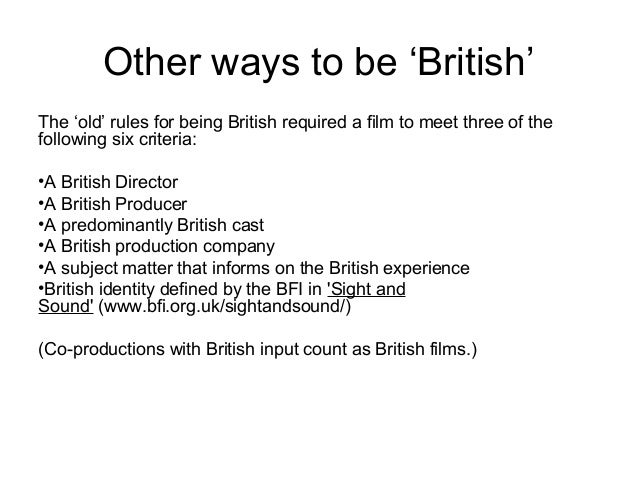
 Far from the Madding Crowd - Aficionados - $30.2 million at the Box Office.
Inbetweeners 2 - Mainstream - $63.8 million at the Box Office.
Macbeth - Aficionados - $5.2 million.
Attack the Block - Mainstream plus - $5.8 million.
Suffragette - Mainstream plus - $14.5 million.
Ex Machina - Film Buffs - $37 million at Box Office.
Why have a British film industry?
The British film industry generates income from big films that are shot here-due to the 25% tax relief - this also means that British workers develop good skills as they take the roles of camera man, producer, editor and other important roles. British films promote British culture and therefore appeal to audiences and make profits for the industry and economy.
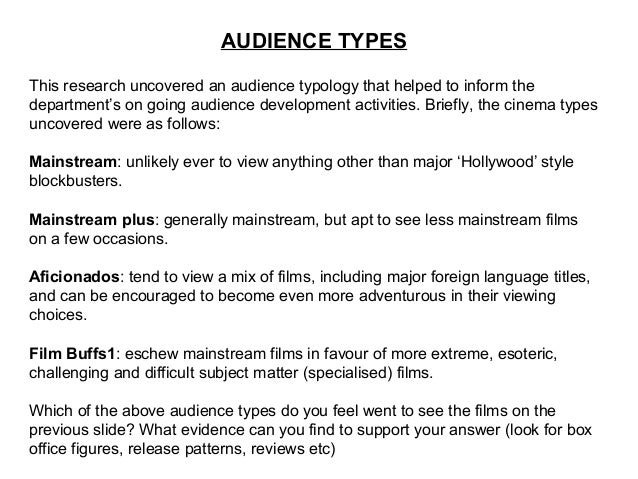
Inbetweeners 2 - Mainstream - $63.8 million at the Box Office.
Macbeth - Aficionados - $5.2 million.
Attack the Block - Mainstream plus - $5.8 million.
Suffragette - Mainstream plus - $14.5 million.
Ex Machina - Film Buffs - $37 million at Box Office.
Why have a British film industry?
The British film industry generates income from big films that are shot here-due to the 25% tax relief - this also means that British workers develop good skills as they take the roles of camera man, producer, editor and other important roles. British films promote British culture and therefore appeal to audiences and make profits for the industry and economy.
Thursday, 19 November 2015
Representation on Ethnicity

How are black, white, Chinese and asian people represented in Tv Drama?
Black: An example of a black character is 'Danny' in 'Danny The Human Zoo'.
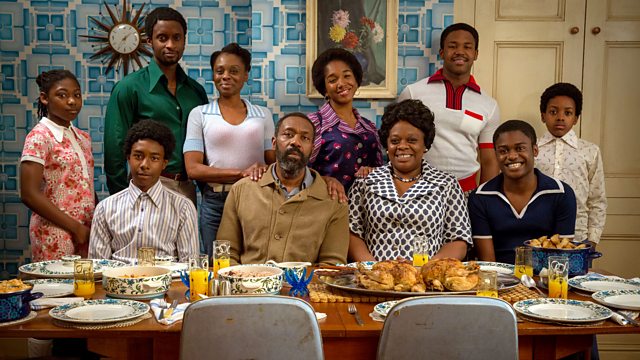
The British TV Drama 'Danny The Human Zoo' portrays black people as exotic by putting them in bright colours, also the show presents a large close family which conforms to stereotypes of black people. Also, the drama shows the racial struggle the main character 'Danny' faces in day to day life therefore supports stereotypes that black people are dangerous or seen as 'different'.
Another example in TV Drama is: 'Empire'

'Empire' constructs a representation of black people as being reckless in position power. Lucius conforms to the stereotype of violence within the black community because he has committed murders and is a intimidating character. Also, the TV Drama supports the common stereotype that black people come from a poor environment and grow up in single parent families.
Bonnie from 'The Vampire Diaries'

Bonnie from 'The Vampire Diaries' challenges stereotypes that black families are very close as her mother and father are not present, she lives with her grandmother and her friends are the closest thing to family. Also, Bonnie fails to conform as she doesn't only mix with people of the same ethnicity which is a common stereotype in the media.
Asian: Navid from '90210'
Asian: Navid from '90210'

Navid is a very rich character with a large family this conforms to stereotypes of very rich asian men that live in exotic homes and drive expensive cars. Also, he is the head editor of the school newspaper and there are storylines related to his academic ability; this supports stereotypes that Asians are very clever.
Anwar Kharral from 'Skins'
Emily from 'Pretty Little Liars'
White: Blair from 'Gossip Girl'
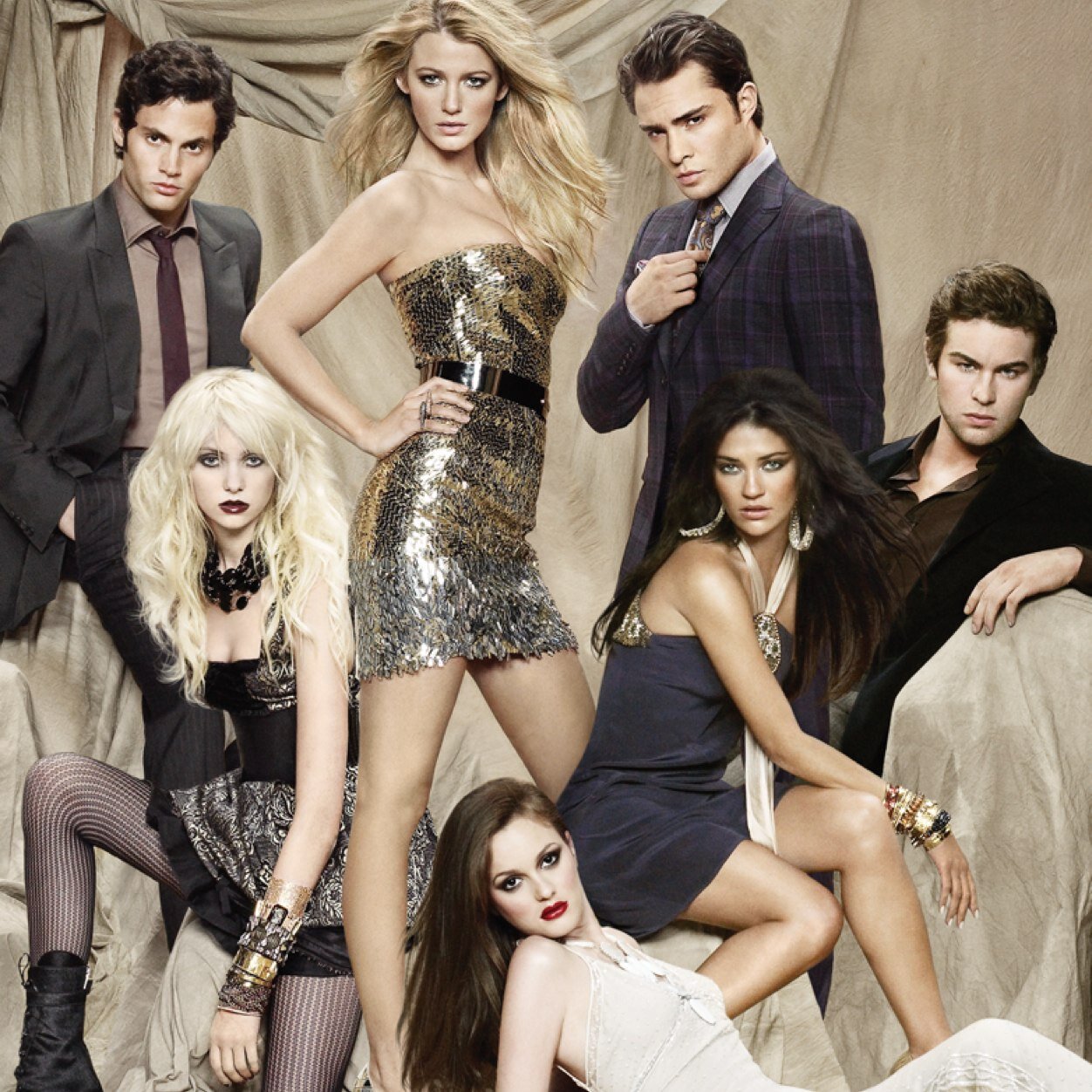
Blair conforms to stereotypical white girls and she is very focused on maintaining popularity, her reputation and always looking the best and having the newest trends. The TV Drama 'Gossip Girl' creates a reputation of white teenage girls to be spoilt and lack appreciation but are intelligent and well educated.
Effy Stonem from 'Skins'
Effy fails to conform to the stereotypes of white teenagers as she is doing drugs and recklessly getting drunk. Effy falls more into the common representation of black teenagers, this emphasises hw rebellious she is and portrays her generation as changing.
Ronnie Brooks from 'Law and Order UK'

Chinese: Agent May from 'Agents of SHIELD'

Miranda Collins from 'Ravenswood'


Glenn's signature item is his baseball cap and he worked as a pizza delivery boy therefore fails to conform to the stereotype of Chinese people having intellectual jobs. His character is resourceful and hopeful therefore does conform to stereotypes, his character is intelligent, calculating, selfless and brave. This positive representation reflects Chinese people to be brave and loyal.
Wednesday, 18 November 2015
Conventions of TV Drama
You will find that TV dramas all have the following ingredients:
- Characters – even particular kinds of characters: eg, at its most simple, ‘good’ and ‘bad’ characters.
- Stories – they all tell stories, whether those stories involve adventure, crime or romance and they often, but not always, end happily.
- The stories are told against familiar backdrops: – eg, homes, police stations and offices (for crime dramas), hospitals (for medical dramas) – most of which are created in studios. However, most dramas also use outside locations to create particular effects.
- Camerawork – particular kinds of shots are used: eg, sequences involving establishing shots followed by mid-shots of characters, shot/reverse shots to show character interaction and, in particular,close-ups to show the characters’ emotions.
- Stories use dialogue to tell the stories. Occasionally, monologues are built in (as voiceovers, a character telling a story).
- Music is used to punctuate the action, create effects (suspense, tension) and underline emotional moments.
- Particular subgenres tend to have items which make them immediately identifiable – police cars, blue lights, operating theatres and scalpels, triage/reception areas in hospitals. Icons of the genre, they symbolise the (sub)genre.
Narrative Codes

Narrative Codes
Roland Barthes developed a concept that every narrative is
interwoven with five codes that drive one to maintain interest in a story. The
first two codes involve ways of creating suspense in narrative, the first by
unanswered questions, the second by anticipation of an action's resolution.
These two codes are essentially connected to the temporal order of the
narrative.
The Hermeneutic Code
The hermeneutic code refers to plot elements of a story that are
not explained. They exist as enigmas that the reader wishes to be resolved. A
detective story, for example, is a narrative that operates primarily by the
hermeneutic code. A crime is exposed or postulated and the rest of the
narrative is devoted to answering questions raised by the initial event.
The Proairetic Code
The proairetic code refers to plot events that imply further narrative
action. For example, a story character confronts an adversary and the reader
wonders what the resolution of this action will be. Suspense is created by
action rather than by a reader's wish to have mysteries explained. The final
three codes are related to how the reader comprehends and interprets the
narrative discourse.
The Semic Code
A seme is a unit of meaning or a sign that express cultural
stereotypes. These signs allow the author to describe characters, settings and
events. The semic code focuses upon information that the narration provides in
order to suggest abstract concepts. Any element in a narrative can suggest a
particular, often additional, meaning by way of connotation through a
correlation found in the narrative. The semic code allows the text to 'show'
instead of 'tell' by describing material things.
The Symbolic Code
The symbolic code refers to a structural structure that organizes
meanings by way of antitheses, binary oppositions or sexual and psychological
conflicts. These oppositions can be expressed through action, character and
setting.
The Cultural Code
The cultural code designates any element in a narrative that
refers to common bodies of knowledge such as historical, mythological or
scientific. The cultural codes point to knowledge about the way the world works
as shared by a community or culture.
Together, these five codes function like a 'weaving of voices'.
Barthes assigns to the hermeneutic the Voice of Truth; to the proairetic code
the voice of Empirics ; to the semic the Voice of the Person; to the cultural
the Voice of Science; and to the symbolic the Voice of Symbol. According to
Barthes, they allowing the reader to see a work not just as a single narrative
line but as a braiding of meanings that give a story its complexity and
richness.
Tuesday, 17 November 2015
Representation Of Disability
TV Drama Representation Of Disability
TV drama is very stereotypical in its representations of
different groups of people. An example of this is disability, there are many
stereotypes that are commonly followed within TV drama of disabled people.
Although, disability is a rare thing to see in TV drama it does in fact occur
and the disability has meaning and impact within the drama. The characters that
are disabled are alienated from other characters and the disability is a large
part of their storyline therefore ruling out the possible chance that a
disabled character could appear 'normal'. A clip I have analysed involves a
disabled man, 'Nick', that is represented to conform with stereotypes of
disabled people, the use of camera shots, angles, movement, editing, sound and
mise en scene all contribute to establishing this character as failing to 'fit
in' with 'the norm' of society.
The clip opens with a shallow focus shot of a metal fence,
this instantly connotes a feeling of being trapped and mirrors the need for
escape. In relation to disability this could infer how a being disabled limits
the actions of a character and how it can effect the person mentally as they
feel scared and trapped. This interpretation conforms to the stereotype that
disabled people are unable to participate in every element of everyday life as
there are many obstacles in their way. The fence suggests prison therefore
embeds disapproval from the audience and when the disabled character is
presented the audience create a perception that this character must be lawless,
sinister or evil therefore this representation conforms to stereotypes in
society. Alongside this opening shallow focus shot is diegetic sound, voices of
men can be heard-accompanied by the image of an out of focus yellow high-vis
vest in the background- suggests that they are on a building site. This normal
life situation juxtaposes the initial emphasis of being trapped to highlight
the way disabled people are alienated in society and stand out among the
masses.
A following shot doesn't reveal the visually shocking
disability of 'Nick', instead it focuses on capturing his peers reaction by
using a close up shot. This highlights the unease with disability in society.
Disability is stereotyped as pitiable or pathetic therefore the reaction of his
peer reflects that seeing 'Nick' is a chore and his company lacks enjoyment.
The clip constructs a representation that disabled people are a burden and
don't blend with society with ease. The diegetic sound of mens voices is muted
slightly as the editors use sound perspective/aural perspective to emphasise
the separation between the two characters, this connotes the divide in society
therefore places the character with disability in a lower status than his peer.
Also, the clip uses shot-reverse-shot once the disabled characters 'mate'
starts a conversation with him, this is used to portray the way his 'mate' acts
towards him and reflects that he feels uncomfortable through his avoidance of
eye contact. This forms a clear representation that disability is an awkward
and slightly taboo situation as many people feel uncomfortable in the presence
of a disabled person due to feeling pity but not wanting to patronise.
Cross-cutting editing is shown between 'Nick' leaving the
building site and going to help a woman with her shopping bags. This reflects
the continuous hard time 'Nick' has in day to day life, it emphasises the
stereotype that disabled people are their own worst enemy; 'Nick' gets
frustrated when things happen that relate to his disability yet it's his facial
disfigurement that is causing the reactions and situations. It is clear that
'Nick' is working class from his clothing and this is reinforced through the
scene where he attempts to help a lady with her bags, she lives in a row of
council houses and her children are shown with typical 'council estate'
haircuts. This portrayal of working class people constructs a representation
that disability is of lower status in society. A long shot reveals a street
empty of people apart from the woman and her children, the scream she lets out
when she seeing his facial disfigurement reflects the representation that a
male with a disability is non-sexual. The TV drama is lifelike and the make-up
that creates the disability on 'Nick' is very realistic to highlight that this
is the way disabled people are treated. A hand held camera is used to produce a
naturalistic effect, it can also reflect 'Nick's' anger at the way others treat
him and act around him, this supports the stereotype that disabled characters
are aggressive and violent furthermore they lack trust and are objectified to
be an element of curiosity. This scene closes with non-diegetic sound, music of
drums builds up and a sound bridge continues the intense music onto the next
scene for a sense of continuity.
A shallow focus mid shot is used to show 'Nick' walking down
a crowded street. This is followed by a series of short mid shots that contain
strangers in the crowd looking at him. Paired with these shots is synchronous
sound- intense music of drums(non-diegetic sound) over fast paced editing shots
of a busy crowd and 'Nick' walking rapidly- to build tension and suspense
within the clip. This sudden change of atmosphere, created by the music, forms
a representation that disabled people are unpredictable, aggressive and not
very friendly or approachable. The mid-shots of strangers create a connotation
that disabled people are an object of curiosity and interest therefore the
representation made within this TV drama conform to stereotypes of disability.
The final scene within the clip I've analysed features
'Nick' and 'the sergeant' in an open office environment. There is a long shot
that effectively grabs the main focus to notice the army painting directly
above the main characters head, this
connotes that Nicks injury was caused in the army. Also, within this scene
there is only diegetic sound of the two characters talking, the flow of
conversation is not interrupted to suggest that the struggles and pain 'Nick'
feels about his disability cannot easily be helped. Shot-reverse-shot shows how
'the sergeant' doesn't look very sympathetic towards 'Nick' but more burdened
by him. This supports stereotypes of disability in society. The use of diegetic
sound, the footsteps, in this scene creates normality therefore builds upon the
idea of alienation and difficulty of fitting in for a disabled person.
Although, the clip is solid in conforming to stereotypes of disability there is
a side profile shot that challenges the expected representation. The side
profile shot of 'Nick' hides his disability and deceives the camera to see a
'normal' person. However, this contrasts with the close up used to highlight
the characters anger and reinforce the representation that he is his own worse
enemy.
The clip shows a strong negative representation of
disability that conforms to stereotypes of disabled people, for example;
pitiable, pathetic, a burden and unable to easily participate in everyday life.
This extract constructs a representation of disability through a variety of
shots to build a general atmosphere and reaction to the disabled character. It
is also prominent to the audience that the character is very unhappy with his
situation, this is shown through the music and range of shots to show the
characters emotions. The media hugely exploits stereotypes because the audience
feel familiar with these representations, therefore a disabled character that
conforms to stereotypes is more widely accepted and understood by the audience.
Subscribe to:
Posts (Atom)